Article
Business Insights | Are we selecting offices for the wrong generation?
Millennials and younger generations now account for over half of New Zealand’s working-age population. The challenge for organisations is making sure they adapt to this generational shift with the right work environment.
January 8, 2026
One of the largest trends impacting the office sector in the 2020s is the demographic shift from the previously-dominant baby boomers to millennials and younger generations.
According to StatsNZ, millennials (born 1981-1996) make up the largest population cohort in New Zealand. Millennials and younger generations now account for 51% of the working-age population. This marks a significant shift from the past two decades when baby boomers were the dominant voices in the workplace.
With the median age now 38.6 years and the proportion of workers aged 50 and over at less than one third, this isn’t a passing trend—it’s a structural change that is reshaping how, where, and why we work. The same demographic forces are at play across the Tasman, where millennials and younger generations now make up over 56% of the country’s workers.
Yet many corporate real estate decisions about location, layout and amenities are still shaped by leaders whose careers were built in a different era. These decisions are often finalised by Gen X and Boomer executives, while the people who will occupy, lead and grow within those spaces belong to entirely different generations with different expectations, social norms and views of what the workplace experience should be.
Spencer Levy, Global Client Strategist & Senior Economic Advisor at CBRE, and Jean M. Twenge, PhD, professor of psychology at San Diego State University, discussed the implications of this generational shift on office workplaces in a episode of CBRE’s ‘The Weekly Take’ podcast.
Twenge points to technology as the main driver of generational change, alongside slower life stages and rising individualism. These forces have reshaped values, how people spend time and what they need from workplaces.
What does that mean for the office? First, work models, she says. “Hybrid acknowledges genuine differences within generations, including Gen Z-ers who value flexibility but also want relief from isolation.”
Preferences within Gen Z are split, which strengthens the case for flexible workspace strategies. Some see no need to commute if tasks can be done at home, while others find home working isolating and want to come in.
“I don’t use the word work-life balance anymore, I use work-life harmony,” says Levy. Twenge agrees that harmony recognises 24/7 connectivity, while protecting boundaries so people can do their best work.
Second, workplace experience. Younger staff members grew up in an atomised media world where social feeds are individualised. Shared, in-person moments that build connection are rarer by default, so offices must do that job on purpose - through precinct choices, layout and amenity that sparks interaction.
Third, fit-for-purpose design. Provide quiet rooms for deep work, enclosed spaces for confidential calls and flexible team zones where people can actually talk.
Today’s workforce spans five generations. What one group sees as ideal, another may find irrelevant or even counterproductive.
When real estate strategies draw too heavily on legacy preferences rather than what today’s employees value, they risk alienating the very people they’re meant to support, says Nick Theyers, Office Leasing Director at CBRE Auckland.
“Design with your people, not at them. Ask teams what helps them do their best work, then invest there to create a workplace your staff will choose to use.”
Executives often prioritise CBD locations, proximity to clients and traditional layouts that support visibility and confidentiality. Middle managers, balancing careers and caregiving, need convenience, predictability and flexibility. Younger professionals seek vibrant precincts, community, transport access and purpose-driven spaces.
The variance in what people want from their offices has arguably never been wider. If your next move is guided by legacy preferences, you risk missing what today’s talent values. A premium CBD address that ignores end-of-trip, transport access and surrounding amenity will underdeliver. Equally, life-stage support matters: dedicated parent rooms, on-site childcare and/or proximity to early learning centres reduces friction for working parents and can lift day-to-day effectiveness.
The generational shift is reflected in data collected during CBRE's annual Office Occupier Survey process. In this year's survey, occupiers were asked which office attributes were most important to their organisation.
The top 10 attributes show that the fundamentals of space and location are central to occupier decision making in 2025, Theyers says.
“End-of-trip and wellness facilities are increasingly important and developers are recognising this, with some new developments now incorporating additional recreational offerings such as gyms, saunas, yoga studios and even golf simulators.”
Floor configuration is the number one priority which occupiers are striving to get right, which shows they are strongly driven to provide an office layout that is most effective for the way their teams work and interact. Occupiers also value high quality both within and around office buildings.
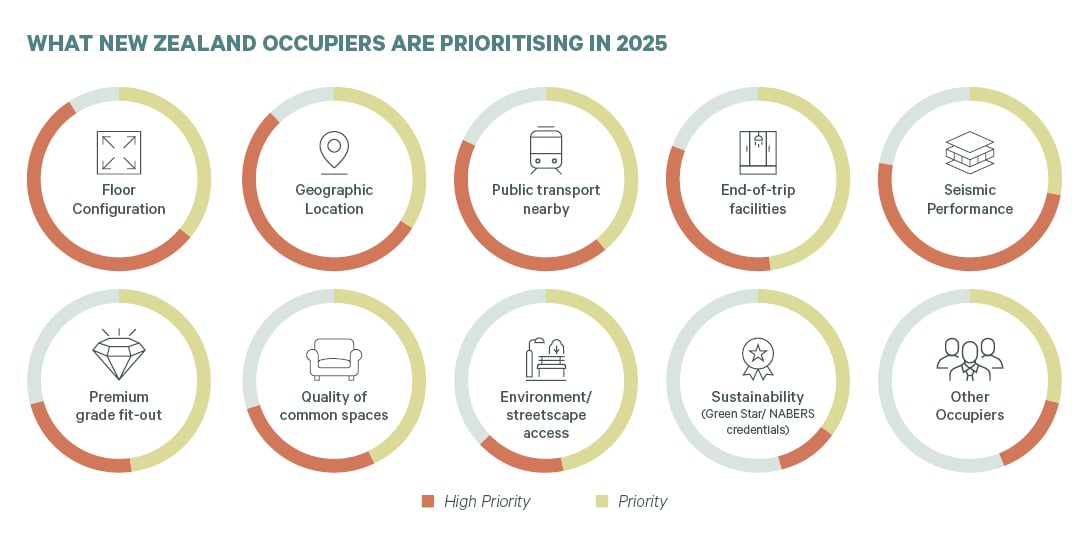
Source: CBRE Research
The right real estate strategy can:
But decisions made purely on cost, tradition or hierarchy can constrain growth, frustrate talent and erode competitive edge.
The decisions you make today about where to locate, how to configure and what to invest in will shape your organisation’s trajectory for years to come. This will enable your organisation to extract long-term value from your real estate decisions, rather than making costly regular changes.
The best real estate strategies should empower the future. Before you sign your next lease, ask:
According to StatsNZ, millennials (born 1981-1996) make up the largest population cohort in New Zealand. Millennials and younger generations now account for 51% of the working-age population. This marks a significant shift from the past two decades when baby boomers were the dominant voices in the workplace.
With the median age now 38.6 years and the proportion of workers aged 50 and over at less than one third, this isn’t a passing trend—it’s a structural change that is reshaping how, where, and why we work. The same demographic forces are at play across the Tasman, where millennials and younger generations now make up over 56% of the country’s workers.
Yet many corporate real estate decisions about location, layout and amenities are still shaped by leaders whose careers were built in a different era. These decisions are often finalised by Gen X and Boomer executives, while the people who will occupy, lead and grow within those spaces belong to entirely different generations with different expectations, social norms and views of what the workplace experience should be.
Spencer Levy, Global Client Strategist & Senior Economic Advisor at CBRE, and Jean M. Twenge, PhD, professor of psychology at San Diego State University, discussed the implications of this generational shift on office workplaces in a episode of CBRE’s ‘The Weekly Take’ podcast.
Twenge points to technology as the main driver of generational change, alongside slower life stages and rising individualism. These forces have reshaped values, how people spend time and what they need from workplaces.
What does that mean for the office? First, work models, she says. “Hybrid acknowledges genuine differences within generations, including Gen Z-ers who value flexibility but also want relief from isolation.”
Preferences within Gen Z are split, which strengthens the case for flexible workspace strategies. Some see no need to commute if tasks can be done at home, while others find home working isolating and want to come in.
“I don’t use the word work-life balance anymore, I use work-life harmony,” says Levy. Twenge agrees that harmony recognises 24/7 connectivity, while protecting boundaries so people can do their best work.
Second, workplace experience. Younger staff members grew up in an atomised media world where social feeds are individualised. Shared, in-person moments that build connection are rarer by default, so offices must do that job on purpose - through precinct choices, layout and amenity that sparks interaction.
Third, fit-for-purpose design. Provide quiet rooms for deep work, enclosed spaces for confidential calls and flexible team zones where people can actually talk.
The long-term impact of the growing disconnect
Real estate decisions are made every five to 10 years, but they affect people every day. From employees and clients to future talent, the office is more than a workplace—it’s a long-term demonstration of organisational values. It reflects your culture, your priorities and your future.Today’s workforce spans five generations. What one group sees as ideal, another may find irrelevant or even counterproductive.
When real estate strategies draw too heavily on legacy preferences rather than what today’s employees value, they risk alienating the very people they’re meant to support, says Nick Theyers, Office Leasing Director at CBRE Auckland.
“Design with your people, not at them. Ask teams what helps them do their best work, then invest there to create a workplace your staff will choose to use.”
Executives often prioritise CBD locations, proximity to clients and traditional layouts that support visibility and confidentiality. Middle managers, balancing careers and caregiving, need convenience, predictability and flexibility. Younger professionals seek vibrant precincts, community, transport access and purpose-driven spaces.
The variance in what people want from their offices has arguably never been wider. If your next move is guided by legacy preferences, you risk missing what today’s talent values. A premium CBD address that ignores end-of-trip, transport access and surrounding amenity will underdeliver. Equally, life-stage support matters: dedicated parent rooms, on-site childcare and/or proximity to early learning centres reduces friction for working parents and can lift day-to-day effectiveness.
The generational shift is reflected in data collected during CBRE's annual Office Occupier Survey process. In this year's survey, occupiers were asked which office attributes were most important to their organisation.
The top 10 attributes show that the fundamentals of space and location are central to occupier decision making in 2025, Theyers says.
“End-of-trip and wellness facilities are increasingly important and developers are recognising this, with some new developments now incorporating additional recreational offerings such as gyms, saunas, yoga studios and even golf simulators.”
Floor configuration is the number one priority which occupiers are striving to get right, which shows they are strongly driven to provide an office layout that is most effective for the way their teams work and interact. Occupiers also value high quality both within and around office buildings.
Designing for life stages: real estate that evolves with people
Real estate is typically an organisation’s second or third largest cost, after talent. The return on that investment is how well it enables people and businesses to perform.The right real estate strategy can:
- support multi-generational productivity by aligning space, location and amenity with diverse workforce needs.
- enhance employee experience, improving attraction, retention and day-to-day effectiveness.
- reinforce brand and culture, sending the right signals to staff, clients and the market.
But decisions made purely on cost, tradition or hierarchy can constrain growth, frustrate talent and erode competitive edge.
The decisions you make today about where to locate, how to configure and what to invest in will shape your organisation’s trajectory for years to come. This will enable your organisation to extract long-term value from your real estate decisions, rather than making costly regular changes.
The best real estate strategies should empower the future. Before you sign your next lease, ask:
- will this space support both today’s leadership and tomorrow’s talent?
- does it reflect who we are and who we’re becoming?
- are we investing for familiarity, or for flexibility?