Article
Business Insights | The art that transforms office lobbies into meaningful places
Substantial, meaningful and timeless art isn’t just confined to galleries and private collections. A quick walk through the office building lobbies in Auckland CBD reveals some large-scale, striking works and significant collections, showcasing the front-row position that art has at the centre of our cities and the built environment. Matt Hockey, Office Leasing Director at CBRE and an artist himself, has watched how art changes the way people move through Auckland’s buildings.
August 3, 2026
Media Contact
Marketing and Pitch Director, New Zealand

Carefully-curated artwork makes an office building more than just a workplace. “Great artwork transforms an office building into an experience and makes spaces memorable. The lobby and other public spaces are usually the first thing that occupiers’ staff and visitors see every day. If it’s done right, art can make people slow down and feel an emotional response.”
With organisations under pressure to ‘earn the commute’ and attract staff to come into the office, art is now even more important as a powerful way to transform offices into engaging spaces.
Research CBRE has drawn on internationally shows that spaces which incorporate high quality placemaking, which includes public art, see ‘dwell time’ rise by around 50 per cent, with sharp gains in positive sentiment and visitor recommendations. Hockey, who is passionate about the artwork displayed in Auckland CBD office lobbies, spoke to some of the people who are closely connected with some of the most prominent works around the city centre. These conversations, highlight some key works in Auckland’s prominent office towers.
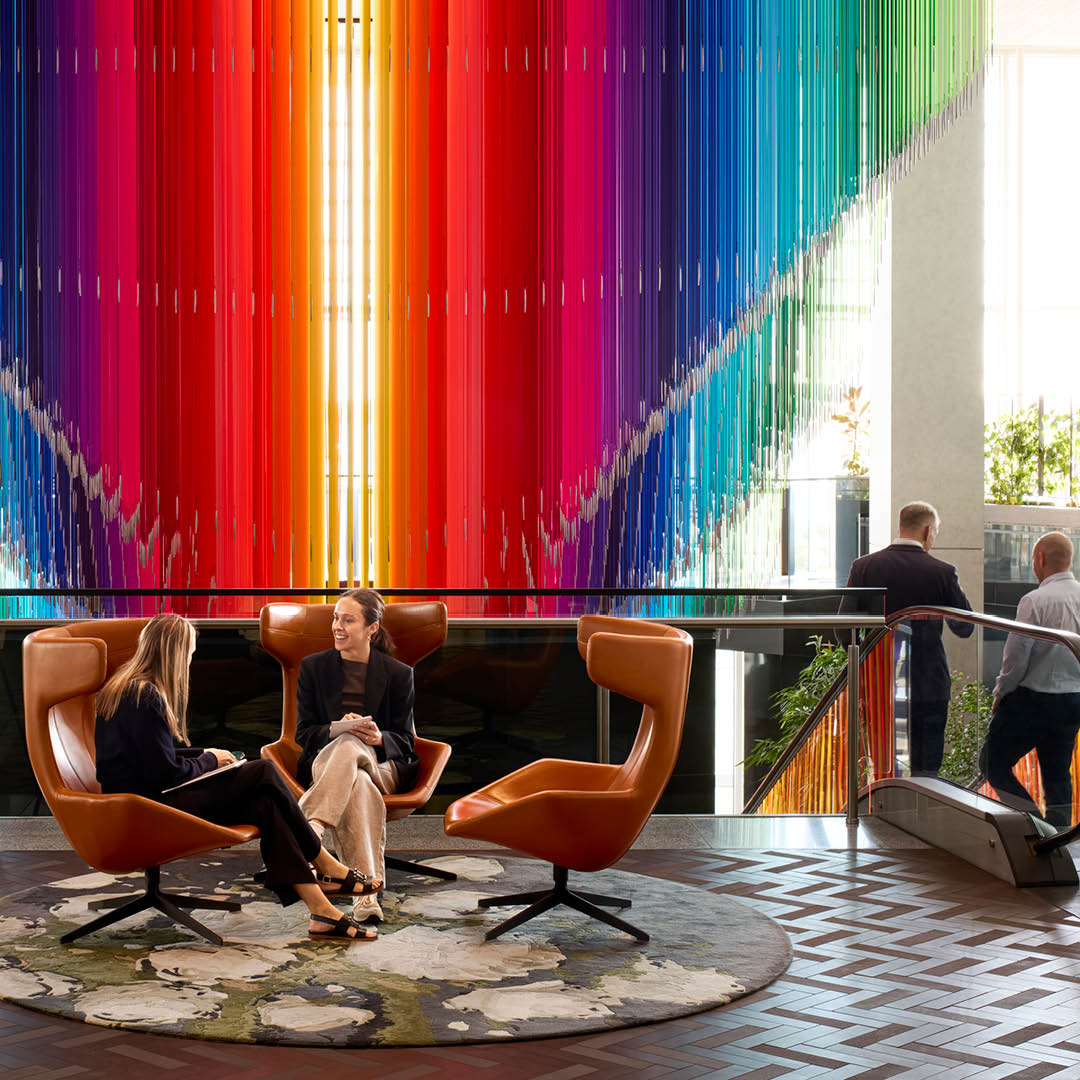
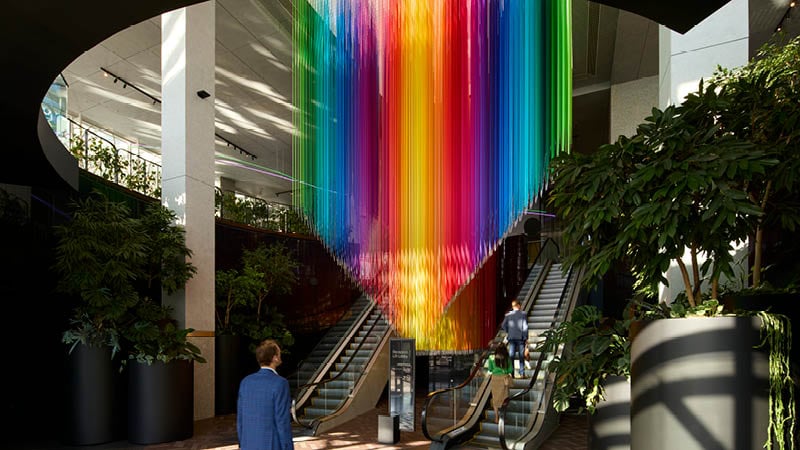
“Several substantial works in CBD buildings have transformed how it feels to walk into the lobby. ‘Ororangi’, the hanging rainbow in the HSBC Tower; and the digital installation in the Vero Centre are just two examples of works that literally stop you in your tracks—but there are many more substantial and meaningful works on display around the CBD,” he says.
Matt Hockey speaks to Anthony Randell, General Manager - Property at Precinct:
- MH: What are you trying to achieve with the art in the public spaces in your portfolio?
- AR: Art brings life, experience and identity into our buildings, particularly in public spaces. These are the first spaces people experience and they set the tone for everything that follows. We want places our clients enjoy being in, not just passing through. Tiffany Singh's ‘Ororangi’ hangs between the escalators at HSBC Tower, a vibrant rainbow installation that has become a real talking point. In the PwC Tower lobby on Customs Street, ‘The Sea Knows More Than Us’ by Benjamin Ball is a suspended stainless steel and enamel work, 13.7 metres long, forming shifting oceanic shapes overhead, referencing the Waitematā Harbour outside the building. At One Queen Street, Nike Savvas’ ‘Aukaha’ suspends 4,420 coloured glass spheres on 340 stainless steel cables, drawing on harbour blues and coastline greens.
- MH: These pieces show you're investing in far more than just building decoration.
- AR: Yes, across our portfolio we've built one of New Zealand's most significant private art collections that is publicly accessible. It's integrated into the experience of our places and shapes how people connect with our buildings every day.
Our client survey this year showed 90 per cent of clients rated our lobby experiences as excellent or good, and I'm confident art plays a part in that. - MH: How do you choose and commission the works?
- AR: It's a collaborative process. We set the direction in-house, aligned with the building and how the space will be used, then work with artists, curators and specialist partners to deliver it. External expertise introduces us to new artists and helps make sure each piece fits the space.
- MH: Have any international lobby spaces shaped your thinking?
- AR: I've seen some incredible lobbies in Australia and around the world. The best do far more than move people through a building—they make staff proud of where they work. For us it's less about replicating what's happening overseas and more about something authentic to Aotearoa, connected to the site, the building and the people who use it.
Kane Goulden, Head of Mixed Use Leasing at Kiwi Property:
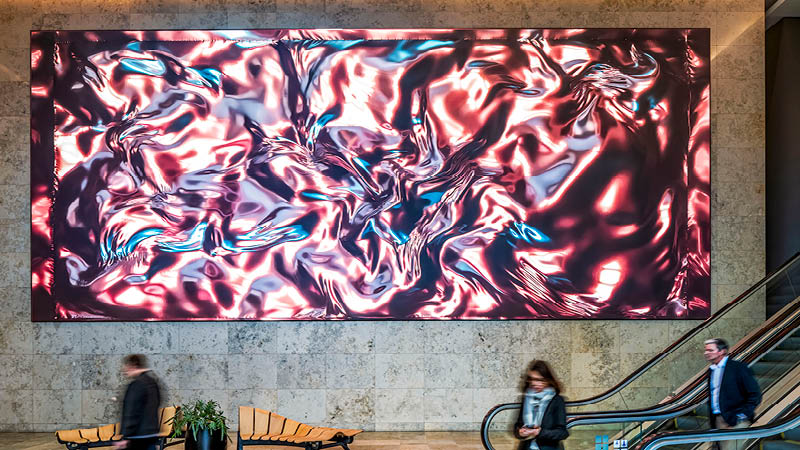
- MH: The new 14 metre by six metre digital installation in the Vero Centre on Shortland Street is a fitting contemporary replacement for the prominent wheel sculpture that drew people in for years. Tell us more about the new work?
- KG: The striking digital work, produced by SpaceSuit & Co, runs at 8K resolution across 22 million pixels with subtle ambient sound. It rotates 25 artworks, among them seasonal pieces and a commission honouring the Drummond wheel that held the space for 25 years and has now been repurposed as a feature in an art trail in Geraldine.
MH: What was the thinking behind going digital rather than commissioning a more traditional work? - KG: There were big shoes to fill in replacing the wheel, and given the size and height of the lower lobby, very few works could do it justice. A large-scale digital piece was the perfect fit. The Vero Centre has had a rich history with art since it opened 25 years ago, and it was important to evolve that, not just continue it. Our tenants love the new installation—many staff and visitors stop and take it in for a few minutes before continuing with their day.
- MH: What should others considering a digital work know?
- KG: The art needs to lead the thinking, with the technical solution following—few digital pieces meet a large screen’s required resolution. Sourcing is important and the real challenge is having enough works to keep it fresh.
- MH: Which international installations set the benchmark for you?
- KG: The Salesforce towers around the world, and 80 Ann Street in Brisbane, have set the benchmark for LED art installations in commercial settings recently.
Matt Cole, Development Manager at Kiwi Property: also shared his thoughts on the installation:
- MH: How has the digital installation helped keep the Vero Centre lobby among Auckland’s best contemporary spaces?
- MC: It’s a genuinely unique point of difference that reinforces the building’s premium positioning. As offices compete on experience and workplace culture, features like this help attract and retain occupiers, and in turn, help our occupiers attract and retain talent.
Trish Clark, curator of the Shortland & Fort collection at 88 Shortland Street spoke to Matt Hockey on her involvement with the tower’s art features:
- MH: How did you plan the major commissions in the building?
- TC: I decided to commission four major artworks that would anchor the building and reference its history. That history was the original Auckland foreshore—the old sea wall that runs along the site boundary. At the entry, Lyonel Grant’s cast bronze ‘Pou Whakairo’ marks the role of Māori and the site’s place on the original shore of the Waitematā. On the east wall of the lobby, Stephen Bambury’s ‘Sightline’, a chemical-action work on 45 copper panels, reads as earth, sea and sky and forms the wall itself.
Jim Speers’ light-box work ‘Miss Ohio’ references the western dusk and evening light. Spanning the forecourt glazed wall, Nike Savvas’ ‘All The Worlds Will Pass Me By’ spins silver, gold and blue mirrored discs that screen the vehicle accessway from view, while protecting the sightlines to the old pōhutukawa of Emily Place. - MH: What separates these pieces from simply decorating the space?
- TC: ‘Decor art’ can only occupy wall space, it can’t give anything back. Real art is timeless and people who work in these spaces gain a huge amount from having art around them. I wanted to present works that prompt different emotional responses: some have calming meditative properties, some evoke a sense of mystery, some are whimsical and others encourage deep thinking. The balance between different emotional states is what makes a space come to life.
I also wanted to embed the larger commissions into the fabric of the building, so the four large commissions are actually fixed into the concrete structure—giving them genuine permanence. - MH: For someone planning lobby art commissions, what considerations are important?
- TC: It’s more complex than it looks and it isn’t just about picking artwork. Volumetric thinking is a key consideration, not just the floor plan dimensions. So I don’t ask clients what artwork they want, I ask how they want the space to feel, and that guides what I choose.
- MH: You’ve seen significant corporate collections overseas. Which have stayed with you?
- TC: The former Chase Manhattan Bank headquarters in New York, which I first saw in 1985, displayed an exceptional collection on an impressive scale. It was seriously avant garde then and it’s still groundbreaking. They were advised by museum curators and achieved a remarkable junction of corporate life and great art, done with real coherence. The Olivetti showroom in Venice is the other standout, one of Carlo Scarpa’s built masterpieces. The entire space is a single piece of coherent art.
Both these works have weathered the decades, and I think more people should aim for that timelessness. You want art to still be meaningful and provoke an emotional response decades later and real art will achieve that.
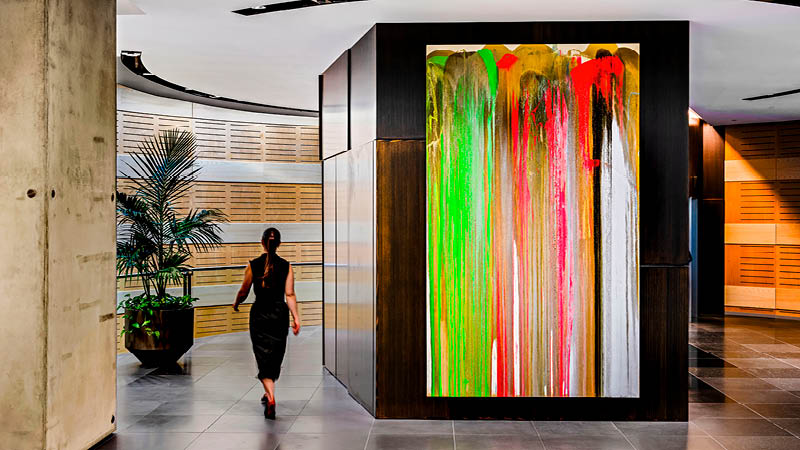
For Hockey, the common thread running through these conversations is that great art is an investment in the people who use a building, not just its walls.
“The best office building art collections give something back to the people who work in them and to the city around them,” he said.
“You see it in the way people stop, observe and talk about artwork on their way through a space. For any occupier weighing up a move, it’s worth spending time in these incredible spaces to experience the difference art can make in prompting emotional connections with workplaces.”