Valuer Insights
Business Insights | Hong Kong Hospitality: Momentum, Structural Shift & the New Lifestyle Era
August 6, 2026
Contact
Senior Manager, Valuation & Advisory Services, Hong Kong

The city's hotel market enters H2 2026 backed by record visitor volumes and a shrinking transient supply — a compelling story for investors and operators who can read the structural signals.
Structural supply dynamics – conversions and the shrinking effective inventory
As of Q1 2026, Hong Kong's hospitality market comprises 333 licensed hotels providing approximately 93,500 operational room keys. These figures suggest structural stability with highly limited new development in pipeline - but the more important story lies beneath: with highly limited new development in pipeline, the effective supply available to transient travellers is compressing significantly.In recent years, asset owners/operators have been shifting existing keys into hybrid models, including long-term stays, serviced apartments, co-living, student housing, and youth hostels. CBRE interprets roughly 18% of the total licensed hotel base now are dedicated for these other hybrid uses.
Traditional Hotel Operation
Remaining traditional hotels capture fluid overnight tourist demand with significant reduced competition. This supply compression is directly boosting ADR and occupancy - a structural tailwind benefiting all transient operators.
Hybrid Operation Model
Properties tap into secular local demand - student leasing, professional residential - while retaining hotel licences for daily flexibility. This hedging strategy provides revenue resilience across economic cycles.
Cyclical renovations are further restricting active inventory near-term. Mandarin Oriental The Landmark completed a multi-month overhaul, reopening guestrooms and suites in June 2026. The flagship Mandarin Oriental Hong Kong is undergoing phased renovation, and The Peninsula Hong Kong is preparing for structural enhancement ahead of its 100th anniversary in 2028 — temporarily removing further room stock from the transient market.
Tourism demand changes – currency, geopolitics and infrastructure
| Market | HKID Appreciation (2018 vs. 2025) |
Arrival Change (2018 vs. 2025) |
Arrival Recovery (2024 vs. 2025) |
Recent FX Trend |
| Japan | JPY/HKD +36% | ▼42% | ▲32% | JPY/HKD -1% (Stabilising) |
| South Korea | KRW/HKD +29% | ▼32% | ▲13% | KRW/HKD +4% (Modest Drag) |
| Overall Inbound Arrival Excl. Mainland China | --- | ▼15% | ▲Recovering | Macro Sentiment > FX Impact |
The 2024–2025 recovery in Japan (+32%) and Korea (+13%) arrivals — despite minimal FX reversal — signals that macroeconomic recovery sentiment is outweighing currency headwinds, a positive indicator for sustained long-term demand from these markets.
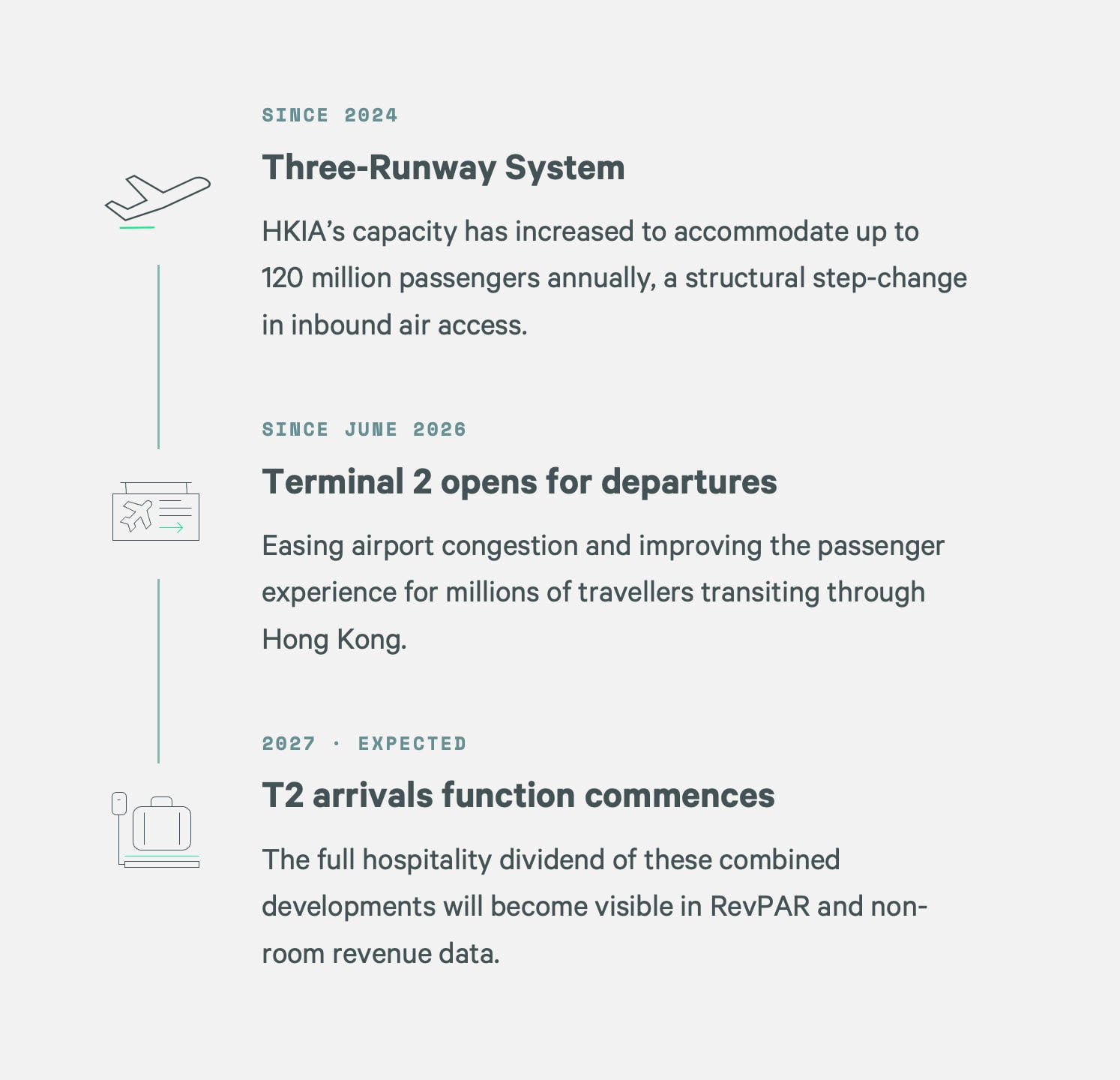
Infrastructure Milestones Supporting Long-Term Capacity
Event Economy Performance and seeking authentic experiences
Foward-thinking hotels are introducing targeted experiential packages tied to major city events, collaborating on local tour curation, and creating social-media-friendly space activations - to maximise asset yields in an experience-driven demand environment.
Lifestyle Hotel Brands: Hong Kong as Asia-Pacific Test Bed
This resonates with the expansion of Hong Kong’s lifestyle hospitality sector highlights a structural shift in how asset value is generated. Modern travellers — particularly younger cohorts — prioritise localised authenticity, distinct design, and digital connectivity over conventional luxury amenities. Lifestyle brands optimise revenue efficiency by converting underutilised public spaces into high-margin social hubs, insulating properties from raw room-rate competition and capturing a higher share of non-room ancillary spend.This trend is actively reshaping Hong Kong's real estate landscape through tactical asset repositioning and premium brand introductions. Hilton chose Hong Kong for the Asia-Pacific debut of its Motto brand with the opening of Motto by Hilton Hong Kong SoHo. Hilton plans to build on this momentum by adding its Curio Collection to the local inventory. This follows the recent launch of IHG’s Kimpton Tsim Sha Tsui, which serves as a global flagship for the brand.
By delivering robust brand differentiation, Hong Kong’s lifestyle segment is well-positioned to achieve superior pricing power and faster RevPAR growth compared to traditional midscale and select-service properties.
Strategic Outlook & Investment Implications
Navigating Hong Kong's hospitality paradigm shift requires developers and investors to update their strategic playbooks — moving away from conventional underwriting toward highly sophisticated asset management. The market rewards those who can balance a compressed transient supply floor (supported by the 18% inventory shift into hybrid models) against a demand baseline that is increasingly experience-driven.Key imperatives: optimise soft assets, maximise TRevPAR through lifestyle brand integration, and strategically time asset positioning with major infrastructure milestones — particularly the 2027 T2 arrivals operationalisation. Geopolitical risk (Iran conflict, oil price volatility, airfare inflation) will temper near-term performance through Q3 2026, but the structural case for Hong Kong hospitality remains compelling.
Translating these complex operational variables into resilient cashflow models and defensible underwriting assumptions underscores the critical role of data-driven hospitality valuation and advisory services.
With our deep expertise in hospitality valuations and advisory, supported by extensive resources and data, our team is ideally positioned to assist developers, owners, operators, investors, or new entrants. CBRE’s Valuation & Advisory Services team offers guidance on site assessments, development feasibility, acquisitions, disposals, redevelopment, repurposing, cashflow analysis, and financial reporting. Contact our experts to explore opportunities in Hong Kong’s promising hospitality sector with informed decision.